Critical praise for Christy!

For "Murder Hooks a Mermaid:"
"Author Christy Fifield creates the kind of characters that stay with you for a long time. Fifield’s new Haunted Souvenir Shop mystery, Murder Hooks a Mermaid has it all: a sunny, relaxed setting, captivating locals, delicious food, and—of course—murder! Delightful amateur sleuth Glory Martine is back with her wisecracking parrot and charming group of friends in this thoroughly entertaining adventure. Don’t miss it."—Julie Hyzy, National Bestselling author of the Manor House Mysteries and the White House Chef Mystery series
"A whodunit with a dose of the supernatural, "Murder Hooks a Mermaid" is a worthy successor to the series opener and showcases Fifield's talents for plotting, characterization and humor." - Richmond Times-Dispatch
"Quirky and unique, a heroine for whom you can't help but root. The story sucks you in." - The Maine Suspect
"With a lovable cast of characters, good conversations and a great setting, this well-written book is a terrific read." -- Dru's Book Musings

For "Murder Buys a T-Shirt:"
A refreshing new sleuth! - Lynne Maxwell, Mystery Scene Magazine
"A fun book that will make the dreariest of days a little brighter! Socrates' great Book Alert" - Socrates' Cozy Cafe
"An entertaining and clever Florida whodunit" - Harriet Klausner
"Hilarious! A great murder mystery with well-written characters" - Paranormal & Romantic Suspense Reviews
For the Georgiana Neverall Series:
"Christy Evans will find legions of fans with this new series" - Sheldon McArthur, Lincoln City News Guard
"Funny and entertaining -- a solid mystery filled with likable characters." - RT Book Reviews"
Cute cozy mystery debute -- wry humor -- adorable dogs" -Publisher's Weekly
"Will have you giggling out loud! Four Stars." - Kathy Fisher, The Romance Readers Connection"The Book is good! Keep them coming, Ms. Evans!" - Mystery Scene
"Evans delivers a fast-paced mystery with admirable finesse!" - Sharon Galligar Chance, FreshFiction.com
"Christy Evans has a hit on her hands" - Harriet Klausner, Bookreview.com
"Christy Evans is aces. I'll be very suprised if Sink Trap isn't an instant hit with cozy readers!" - CozyLibrary.com

Showing posts with label Haunted Souvenir Shop. Show all posts

Sunday, May 15, 2016

The More Things Change

I have been missing in action from this blog (and most everything else) for several months, though not exactly by choice.

Image result for ambulanceA few days after my last post I got shoved into an ambulance—again!—and taken back to Oregon Health & Science University.  Again.  All the way there I kept telling myself this was just a research trip, a way to write more knowledgeably about ambulances.  It didn't change the fact that I was admitted to the hospital and stayed for another surgery.

 I didn't stay as long this time, and my recovery was textbook-perfect, but I have been focusing on my own health and well-being since.  I found the walking and yoga I'd been doing made a tremendous difference in how quickly and thoroughly I bounced back, physical therapy can do amazing things, and attitude is everything.  I may not be 25 any more, but I definitely feel better than I have in a long time.

There were other changes, too.  The one most significant for the readers of this blog is the future of the Christy Fifield books.  Unfortunately, Berkley Prime Crime has decided (after many months of wavering) that they will not publish another book in the Haunted Gift Shop series.  I am disappointed, but it appears that many series are ending as Penguin/Berkley adjusts to the merger with Random House.  Fortunately, in the modern publishing world it doesn't mean the series has to end, as writers can move to indie publishing and readers can follow them.  Now that I have an answer from Berkley, and am back on my feet, I am working on book #5.  The adventures of Glory, Karen, Jake, Riley, Felipe, Ernie, Sly, Bluebeard, and all the rest will continue!

In addition to the Haunted Gift Shop, I hope to launch a new series, The Spy Girls.  I have always been fascinated by the women of the Second World War.  They were the first generation to move into the workforce—in what were then non-traditional jobs—in large numbers, and they showed following generations that women didn't have to be relegated to "nurturing" roles (mothers, teachers, nurses).  They were, in my mind, the proto-feminists that laid the groundwork for all women to come.  I already have five short stories about my fictional spy girls, and they will be coming out over the next few weeks, and I plan to follow the release of the stories—singly and as a collection of all five with the possible addition of bonus material—with the first novel in what I hope will be a series.

The short stories explore the backstories of the two main characters, culminating with their meeting in the final short story, "Swamp of the Prehistoric Clan."  This story originally appeared in the anthology Fiction River:Recycled Pulp from WMG Publishing last September. Being me, I wrote a cozy mystery about two women who meet in a retirement community in the 1970s.  They both have their secrets, but eventually they will discover they have one in common: they both served in clandestine services during World War II.  Imagine Peggy Carter in retirement, trying to content herself with bridge tournaments and Tupperware™ parties.  Yeah, like that's gonna work!

There are more changes to come over the next few months, and I'll be talking about them here as time goes on.  Until then, thanks for your patience while I recovered!

Thursday, June 25, 2015

Reading Aloud

As many of you know, I suffered a serious illness a couple years ago, and spent an extended time in the hospital.  And, as I have talked about before, my husband read aloud to me when I was too weak to hold a book or focus enough to read.

All the nurses on my floor knew him - at 6'6" he stands out - but he was identified more by the way he treated me and looked after me during those weeks.  Especially the reading.  Sometimes he would catch a nurse lingering by the door, listening as he read.  They told me later that he was a keeper, they didn't often see that kind of devotion.  But I already knew that.

What those nurses didn't know was that this wasn't the first time he'd read to me.  In the early years of our marriage we settled the issue of who got to read Dave Barry's Sunday column first with an elegant solution: he got the paper first, but he read the column aloud - at least he did when he wasn't giggling madly over something Barry wrote.  (Confession time: I was usually in hysterics, too.)

Over the years we've been together (32 and counting) we have often read to each other.  I would find a passage especially amusing or amazing or enlightening, and I would read it to him.  He would do the same to me.

That's how he finally read the Harry Potter series.  We were on a car trip, I read him an early passage in Sorcerer's Stone (I was re-reading books 1-6 in preparation for the release of 7.  Yes, I am a nerd!) and he was hooked.  We traded off reading and driving the rest of the trip, and he dove into the remaining books as soon as we got home.

Reading to each other on car trips has become something of a tradition.  We've read thrillers and mysteries and science fiction, but primarily we read non-fiction.  And I look forward to those long hours on the road, listening to my dear husband read me something I might not have chosen on my own.  I hope he feels the same.

All of this is background, leading up to a discussion of the book we read on our last road trip.  Steve found it in Goodwill a few weeks back, we read a few pages, and decided it would be perfect for our upcoming drive to Reno.  It definitely was!

The book is The Lizard King by Bryan Christy.  Set in Florida (just like my Haunted Souvenir Shop series!) Lizard King tells the story of a dedicated Fish and Wildlife agent and the suspected smugglers that become his obsession.

Here's what Amazon.com's reviewer had to say:
Reptile smuggling is big business, and in his book debut, Brian Christy mounts an intense and highly readable investigation into this unique black market's surprising depths. Besides the reptiles themselves, this exciting narrative investigation focuses on two main protagonists: Michael Van Nostrand, a notorious dealer; and Chip Bepler, the Fish and Wildlife Service agent whose single-minded aim was to bring the former to justice. --Jason Kirk
While the Publisher's Weekly review (also on the Amazon/com site) has some issues with the book, we didn't find the narrative disorienting, instead enjoying the fascinating tale of cops and robbers.  It's like The Sopranos, but with snakes and lizards instead of arson, drugs, and murder - though I'm not saying you won't find some of those things in The Lizard King!
This one gets two thumbs up from the York Writers! And just maybe we will see some of those things show up in future Haunted Gift Shop stories...

Thursday, January 2, 2014

A New Release, and a New Year

In another week MURDER SENDS A POSTCARD, the third book in the Haunted Souvenir Shop series, will hit the shelves.  I hope you will all enjoy the latest adventures of Glory and her pals.  I truly appreciate all my readers who have waited patiently while I dealt with all the life issues that knocked me down - but not out!

Later today I will head in to the office to deal with some payroll duties that need to be taken care of, but right now I am enjoying a quiet New Year's Day, watching the end of the Rose Parade.  It's been a great morning, thanks to a local Los Angeles television station.  Let me explain...

With the New Year comes a life-long tradition: The Rose Parade.  In recent years I have become more and more disillusioned and disgusted with the various networks' coverage.  Dozens of bands that we never heard because they talked over them, floats barely glimpsed because the camera was on some "guest" in the broadcast booth (who just happened to be the third lead of one of the network's series), equestrian groups that didn't even get identified, either by the commentators or with a title card.  I missed the PARADE.

Today was different.  I found the KTLA.com website with a live feed of their coverage.  Which was EXCELLENT!!  They shut up and let us hear the bands.  There were no guests, or lingering shots of the commentators, no pre-taped segments to interrupt the actual parade; camera lingered on the floats and the horses.

I was especially grateful because this year I had a personal connection to one of the floats and cared deeply about another.  The personal connection was to Donate Life-one of the pictures was of my son's friend Erich Vogel, a wonderful young man who left a young widow and a toddler son, but saved many lives by his generous organ donation.  The other float was from the Wingtip to Wingtip Association, celebrating the Women Air Force Service Pilots of WWII.

AND I got to hear one of my heroes open the Parade, Grand Marshal Vin Scully-one of the greatest broadcasters who ever lived.  (I was also able to watch the feed on my tablet, which solved the whole issue of "I don't want to get out of bed.")

I grew up in the LA-area.  I've seen the parade in person several times, including the year I could walk from my rental house just five blocks from the parade route down Colorado Boulevard, the year I slept on the sidewalk with college friends, and the year I was in the stands at the Marine Armory at the end of the parade.  President Eisenhower (that year's Grand Marshal) walked within a few feet of where we were sitting, and I remember how much that meant to my mom..  I worked on parade floats as part of a youth-group fundraiser while I was in high school and college.  Before that, as a kid I watched the parade with mom and the other kids.  This parade has been part of my life since, well, forever.

Thank you, KTLA, fir giving me back my parade, and restoring my tradition!

Tell me, friends, what tradition have you lost and found again?

Tuesday, June 18, 2013

The Sound of Breaking Glass; or, Engage Writer Brain

Somehow this post never got published.  Let me take care of this Right Now!!

There are times when it is extremely difficult not to indulge in the time-honored writer habit of Making Things Up.  It is, after all, what we are paid to do: sit alone in a room and Make Things Up.  I've talked about that before, but it's a part of an incident that happened last week.

L. to R. Barton Grover Howe, Christy Fifield, M.L. Buchman
I was in a friend's shop for a book signing of Murder Hooks a Mermaid.  It's a combination antique shop and bookstore, a delightful jumble of treasures from the last two centuries, collectibles (especially glass and apothecary items), and new and used books.

I was at one end of the shop when I heard a noise near the cash register.  The sound of breaking glass.  That's a scary sound in a shop full of breakables, but it got worse.  The noise didn't stop, and it was accompanied by the crash of something heavy falling over.

Before
Another customer, a woman with two bargain-table books in her hand, had jostled the owner who was walking behind her, knocked him over and in the process knocked over an entire display case.  She managed to topple thousands of dollars worth of antiques.  She knocked over one display case, thereby breaking out the glass front of a second case, and destroyed an entire case of antiques, including some unique and irreplaceable pieces.

And After
She asked the owner something like "Did I do that?" in a way that clearly implied that she didn't, and hurried out of the store, leaving her books on the counter.  Fortunately, the store is insured, and no one was injured, in spite of the piles of broken glass.  But the emotional impact of losing several irreplaceable pieces is a blow my friend will need time to recover from; and we don't know yet what the financial implications will be.

As my husband and I talked about it later, I had to keep from ascribing motives to the woman who knocked over the display.  It felt as though she high-tailed it out of the store without any attempt to take responsibility for the destruction she caused.  But maybe she truly believed she was innocent and left because she was embarrassed.  As I said, I was making things up.

I also realized that, given what I've been writing, this scenario (or something very much like it) will undoubtedly appear in a future book.

And this is where the Writer Brain comes in.

Writer Brain is a symptom all writers seem to manifest.  It is that moment when you detach from some awful event and start storing details to use later.  It's a way of dealing with painful or disturbing situations.

An example?  At the beginning of my summer medical odyssey I took an ambulance ride.  About ninety miles with lights and sirens, in the middle of the night, headed for a regional medical center and emergency surgery.  It should have been terrifying and stressful, and to some extent it was.  But Writer Brain took over.  It quickly occurred to me that this might be the only time I got a close-up look at the inside of an ambulance and I started looking around, trying to store up all the details I could, to use later.

So last week's disaster will show up in a book sometime, just as calls from our police scanner have formed the basis of certain scenes, and other painful - or joyous - personal experiences have informed other stories.

It's the curse (and the blessing) of Writer Brain.

Wednesday, January 2, 2013

A New Year, and a New Release

2012 is finally a fading image in my rear view mirror.  It's been a tough year, maybe the toughest year I have ever faced.  But today, with the arrival of 2013 I am able to put the old year behind me, and look forward to the new.  Sure, there will be challenges, and I am not 100% just yet, but I am much better than I was a month ago, and miles better than the month before that.  On the 10th of December last year (man, am I glad to be able to say that!) the wound care facility declared me healed, and officially released me from all follow-up care.  Much as I appreciated all they did, I was just as glad to say good-bye.  It was a friendly break-up though, and I took them some lovely parting gifts.

The other good news today is the release of Murder Hooks a Mermaid, the second book in the Haunted Gift Shop series, along with my friend Julie Hyzy's Fonduing Fathers (Thanks, Julie, for the great review posted above).  Here's the cover blurb:

Nestled in Keyhole Bay, Florida, Glory Martine’s souvenir shop, Southern Treasures, is supposed to trap tourists—not ghosts. But a possessed parrot may be just what Glory needs to solve a murder...

Inheriting her great-uncle Louis’s bayside souvenir shop should have been a breeze for Glory. Instead it’s been one headache after another—with a lot of them generated by Bluebeard, a parrot with a mouth like a sailor and a personality a lot like her late great-uncle. But Glory’s troubles pale in comparison to those of her best friend Karen, whose ex may still have the personalized key chain to her heart, but whose brother-in-law is about to get locked up.
A diver has been found with a gaff hook in his chest, and Karen turns to Glory to help get her brother-in-law off the hook for his murder. But casting the net for the real killer won’t be easy. Glory and Bluebeard are about to find out that the secrets in Keyhole Bay run deeper than anyone ever imagined…


Yep, we get to know Karen's ex, who made a cameo appearance in Murder Buys a T-Shirt, as well as his troublesome brother.  There's more Bluebeard, and more Jake, and especially more of Sly and Bobo.  I didn't know those last two were going to turn into such important characters when I started this series, but once they showed up I knew they had a story to tell.  (And there's also more of Sly's story coming January 15th at Dru's Book Musings.)

I am currently working like mad on Book 3, with a working title of Murder Sends a Postcard, which should be out late this year (Yay, 2013!).  As always, if you want a signed copy of any of my books you can contact my local booksellers: North by Northwest Books and Antiques,  or Bob's Beach Books.

Monday, October 15, 2012

The Great Cookie Mystery

With all the Southern cooking going on around our house as research for the Haunted Gift Shop series (hey, it makes a good excuse!), I am constantly picking the Official Taster's brain for ideas.  I want to know what dishes he remembers from his childhood, the things his mother, grandmother, aunts, friends, and neighbors cooked.

One evening recently, he started telling me about a cookie his Mema used to make.  He couldn't remember what she called them, but as he talked, I realized he was describing what I knew as a Russian Tea Cake.  Curious, I called on my Google-fu and started looking for recipes and history.  What I found was a basic shortbread cookie with nuts added, and many, many names.

What do YOU call these?
Online, I found Russian Tea Cakes, certainly.  I also found Southern Butterballs, Viennese Crescents (though with a variation in shape), Biscochitos,  Kourambiethes, Moldy Mice, Rohlichky, and Mexican Wedding Cookies.  At work, I offered several people samples, and asked what name they knew them by.  My boss, who grew up in Pennsylvania, called them Italian Wedding Cookies.  Another friend said they were Mexican Wedding Cakes, and a couple Mexican friends identified them as Polvorones.  Intrigued, I went back to online searches, and found Polvorones, with the speculation that the name was derived from the word "polvo," meaning dust, or powder.  Other friends called them simply Wedding Cookies.

I found versions with pecans, hazelnuts, walnuts, almonds, and poppy seeds.  Some recipes called for an egg, others did not.  There were variations with all butter, all lard, or a combination of the two.  The ratio of flour and sugar to ground nuts varied from 4:1 to 1:1.  Some had vanilla, some cinnamon, some chocolate, and one included orange zest.  Polvorones are said to date to 16th century Spain, with several regions claiming ownership, and some references claim the Spanish were introduced to them from Medieval Arab cuisine.

Of course I had to make a batch, which the Official Taster pronounced good, but not exactly the same as Mema's.  However, there are dozens of recipes for every one of the many names, so I'll keep experimenting until I find that magic combination that perfectly matches his recollection.

Making the cookies:
I started by toasting the pecans.  I have a stash of very good pecans in my freezer, thanks to the generosity of my mother- and father-in-law, who harvested them from their trees and shipped them to us.  I placed a single layer on a cookie sheet in a 350 degree oven for about five minutes, then let them cool.  This richens the flavor and helps reduce the tendency to turn into paste in the food processor.  When they were cooled, I put them in the food processor with a tablespoon or so of flour (another trick to help you get chopped, not pureed, nuts) and pulsed it until the nuts were finely chopped.


A few simple ingredients is all it takes
With the nuts ready, I measured the flour, powdered sugar,and vanilla, and softened two sticks of butter.  These are very rich, though they don't have a lot of sugar; the flavor comes from the butter and the nuts.

The butter should be at room temperature, soft enough to work.  The dough can be mixed by hand (which I did) but a stand mixer is well-suited to this dough.  If the butter isn't soft enough, give it a few seconds in the microwave.
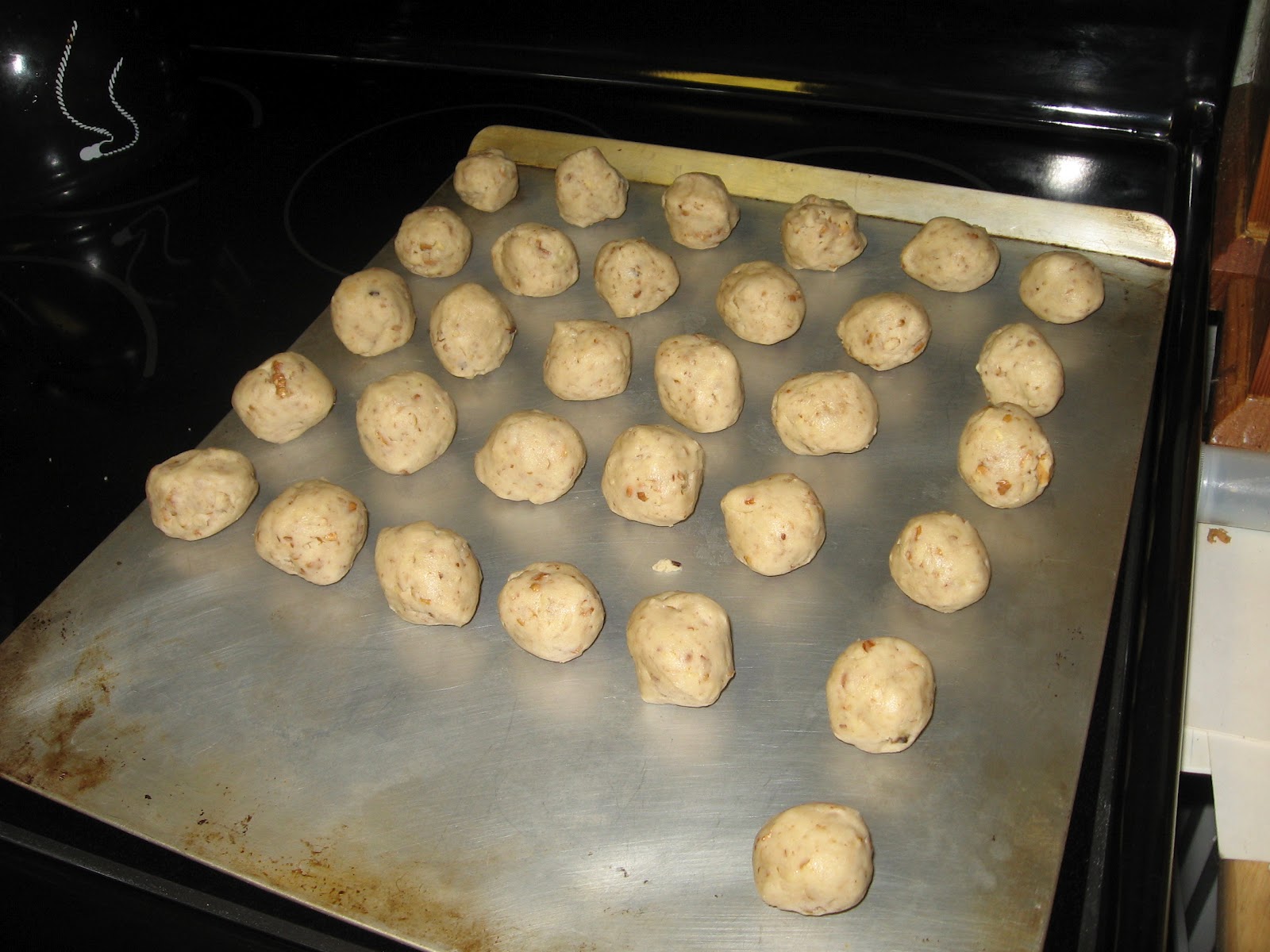
Mix the flour, powdered sugar, nuts, and vanilla into the butter, just until it forms a ball in the bowl.  You want the dough to hold together, but don't overmix.  Refrigerate the dough for an hour or so, in order to make it easier to handle, then form it into small balls on an ungreased cookie sheet.


Cookies ready for the oven


Bake at 350 for 10-12 minutes.  They will be faintly golden.


After baking.  Gold, not brown
Now comes the fun part.  Let the cookies cool for a couple minutes on the baking sheet, then roll them in powdered sugar.As each cookie is rolled in the sugar, place it on a cooling rack.  The sugar will cling to the hot cookies, but it will tend to melt into them because they are still warm.  That's just fine.


You're going to get sugar on your fingers, and that's okay!
 Resist the temptation to nibble, and let the cookies cool.  Because once they are cool, you are going to give them another coat of powdered sugar.  You can also sift powdered sugar over them, but I like to roll them, making sure the entire surface of the cookie has a coating of soft white.

One tip:  If you place your cooling rack over a clean cookie sheet, you can use the powdered sugar that falls off to roll the cookies the second time.  Because there will be sugar that falls off!
After the second coat of sugar, the cookies are ready to be packed in an airtight container, and enjoyed for several days, or weeks.  As if there will be any left that long!   

With a second coat of powdered sugar. Yummy!!

The Cookies of Many Names

2 sticks butter, softened
2 cups flour
2 cups chopped nuts - your choice of pecan, walnut, almond, or hazelnut
1/2 cup powdered sugar, plus more for coating
1/2 teaspoon vanilla

Mix dry ingredients into softened butter, along with the vanilla.  Stir, or mix at low speed on stand mixer.  When the dough forms a ball in the bowl place it in the refrigerator for an hour.  The cold dough will be easier to handle.

Preheat oven to 350 degrees.  Remove dough from refrigerator and roll into small balls, about the size of a walnut.  Place them about an inch apart on an ungreased cookie sheet, and bake for 10-12 minutes, until they turn light gold.  Remove from oven and allow to cool on the cookie sheet for a couple minutes.

While the cookies are still warm, roll them in powdered sugar, coating all sides, and place on cooling racks.  Once they have cooled completely, roll  them in powdered sugar again, and store in an airtight container.

Sunday, July 8, 2012

Panhandling Part 3: Christy and husband Steve Discuss Murder and Mystery on the North Florida Coast

Christy and husband J. Steven York  continue discussing their respective mystery series, both set in the Florida panhandle:

CHRISTY:  When I mentioned colorful characters, I immediately thought about Big Bass, the chief of police in your Panorama Beach stories.  Is he based on anyone you knew, growing up in the South?  I know I've heard stories about a lot of the people that lived around you when you were a kid, but I don't remember any law enforcement people specifically.

STEVE: In Alabama (about 15 miles from the Florida line) we were so far out in the country that we didn't see the law much.  State troopers would cruise through once in a while, and being a fan of cops on TV (re-runs of the old series "Highway Patrol" were a special favorite) I always paid special attention to the cop-cars and motorcycles around city hall.  But as for actually having much to do with actual officers, I don't much remember it.

No, Big Bass is more based on an idea than a person.  Thinking back about the south in that part of the 60s, the legality of segregation in every aspect of society had been broken, but it was still deeply ingrained in the culture.  It struck me that for anyone with visibility to be at all fair-handed with blacks, you had to be something of an outlaw.  Somebody like Big Bass could only survive if he hid his true nature, played the good-old-boy game, and kept enough political dirty tricks up his sleeve to keep himself on top.  So in some ways Bass is that hoariest of southern cliches, the crooked Sheriff.  But he turns that cliche on its head in that he is (sometimes, anyway) a force for good.  Certainly he sees himself as the hero of his story, and he does try to help people and keep his beloved beach from being despoiled.  But his methods are questionable, and he stumbles over to the dark side if there isn't somebody there to turn him back.  Fortunately, there are people to do that, and one of them is Deputy Mustang Sawtell.

Mustang is based on a lot of people I knew, and on some level, he's based on me a little, too.  And I think there's some of my late uncle Wayne in him.  But there's a little of every good-hearted southern boy I've ever met in him.  That's his core.  I just feel that at the core, the character of southern people is kind and generous and hospitable.  But it's also got this strong tradition of intolerance that, to my mind, seems completely incompatible with that.  That dichotomy isn't a southern thing, it's a human thing, and that's a big theme of the Panorama Beach stories.  It's about doing the right thing the best you can when there's nobody to show you the right way, and everything is trying to steer you wrong.  And it's about how good people sometimes do things that are unspeakably evil.

That's really the biggest difference between our two series I think.  In some ways, 1967 and 2012, they might was well be different planets, even through we're talking only a few miles apart.

CHRISTY:  And yet some of the themes you're working with are so universal that they fit any time, and any place.  In writing murder mysteries, we're dealing with characters who do things that are unspeakably evil, who violate the biggest taboo: the taking of a human life.  It doesn't get much worse than that. 

But if we are to create a believable bad guy, he has to have an understandable motive.  He has to think he is doing the only possible thing to achieve his goal, whatever that goal is.  The path that the character takes to  the point where he (or she) commits murder has to make sense to the reader.  Similarly, a character like Big Bass has to make sense within the context of his world, within his definition of necessary actions.

In my books, the victims are killed for a reason.  It might not be what you would call a good reason, but nevertheless the killer must come to a point where killing another person seemed like the only logical path.  And unlike Big Bass, there isn't anyone to pull them back from that murderous impulse.

As you said, however, the South of the 60s and the South of today are definitely different.  Race certainly continues to be an issue within our society, but it does not dominate our social interactions the way it did fifty years ago.  In the Haunted Gift Shop series, I barely touch on the issue, except in occasional historical context.  In fact, I have an interracial couple as secondary characters, and their race is hardly an issue.  The fact that they're gay, well, that may occasionally create problems.

I've noticed something else about your characters, something that certainly reflects the time in which your stories are set.  Many of your characters are military veterans.  What drew you to that background, and why do you think you've made that a central part of so many characters?

STEVE: You know, sometimes you sit down and say, "this is a theme I'm going to write about," and sometimes theme just develops out of story and character.  That's what happened here.

Early on I had the idea that Mustang Sawtell's best childhood friend would have been killed or be MIA in Vietnam, that he would have left him with this Mustang convertible that he drives, that Mustang had never served in the military, and that this would be a source of guilt and conflict for the character.  But as I started writing, it kept coming up again in different ways.

First of all, the military was really pervasive in that part of Florida in those days (and still is).  Panama City had Tyndall Air Force Base, and Eglin Air Force Base near Ft. Walton takes up a huge part of the panhandle with its bombing ranges and satellite airfields.  Then there's the huge Naval Air Station in Pensacola.  It's a very important place for the military, especially military aviation, and it was really buzzing in the 60s, what with Vietnam and the cold-war both in full-swing.  There were military planes in the skies all the time, and you saw military personnel everywhere.

But it's also a matter of history.  In 1967, the WWII generation was in charge of the world, but they were graying, and the world was starting slip from their grasp.  Sheriff Bass is an example of that generation.  We're going to learn that he was a great hero in the Pacific in WWII, saved a lot of lives, and has a lot of friends who remain very loyal to him because of it.  But he also did a lot of bad things in the service of good, and it damaged him in many ways.  He's a danger junkie, and in many ways ruthless.  He's killed many times, and he won't hesitate to kill again if he thinks there's just cause.

Then there's Korea, "the forgotten war," dismissed by many of the WWII generation as "not a real war," and the veterans often treated poorly in a way that echoes the later experiences of Vietnam vets.  My next Panorama Beach Mystery, "The Beat of Angels Wings," delves deeply into this.  It's about a tight group of helicopter pilots who flew air-ambulance missions in Korea, a secret they all share, and how the war has changed them all.  We're also going to reveal that one of our established characters is a Korean vet, someone people might not expect, and their experiences there play a big part in their life.

And of course, Vietnam is looming, not just in Mustang's lost friend, but in the growing unrest in the country that will figure into future installments.

Goofy Golf, Panama City Beach, 1960s
Hmm.  This is getting a little dark and serious.  Let's shift gears and talk about something that I know drew both of us to write about North Florida: the strange, wacky, and wonderful sights and landmarks, both natural and man-made, that dot  (or in some cases, used to dot) the area.  Like some of the things that inspired aspects of Keyhole Bay in your books, and the strange attractions in Panorama Beach.

CHRISTY:  Keyhole Bay is a modern-day tourist town, with all the plusses and minuses that go with an economy based on a constant flow of strangers. In that sense, it has a lot in common with tourist towns across the country; only the geography changes.

The first time I visited Florida, and traveled through the Panhandle, I was astonished.  I'd grown up near the beaches of Southern California, and thought I knew what a beach was all about.  Boy, was I wrong!  The sand was whiter than anything I had seen on the West Coast.  It looked like snow!

All along the coast there were touristy places; restaurants and lodging, of course, but also go-karts, mini golf, souvenir shops, T-shirt shops (LOTS of T-shirt shops), and assorted other attractions.  The wacky, kitschy, slightly tattered tourist attractions had not yet given way to high-rise condos, and I felt like I was a teenager again, at some of the places I'd known in Southern California in the 60s.

In Keyhole Bay, geography has shaped the history and personality of the town.  The small harbor supports both commercial and recreational fishing, and the proximity of the Gulf provides amazing scuba diving opportunities.  So, while it shares much with other tourist towns, it has its own unique attractions.  In Florida, it's all about the water.

One of the places that intrigued me most was DeFuniak Springs, not only for the Chautauqua connection, or the beautiful houses, but for the almost perfectly-round lake.

STEVE:  I loved that lake the first time we saw it.  I'd been driving by it several times every summer, but until a few years ago while visiting with you, I'd never gotten off the main road to see it.  It's like stumbling into some kind of fantasy: the placid, round lake, the historic building, the quaint little small-town main street, the railroad station, and then there's the library.

You go into this tiny little library, and every available wall and shelf that isn't full of books is full of medieval weapons!  It's right out of "Buffy the Vampire Slayer!"  The place demands to be written about, to have some thin layer of fantasy or imagination.  It's a hell-mouth.  It's a star gate.  It's a time-window.  It's the lair of a sea-monster.  It's a bay on a magical fairy ocean in another universe.  It's a place where true love lasts forever.  It's the small town that just happens to be the center of the universe.  It's a town where time moves in circles and loops back on itself in infinite combination.

Sometimes it's that way.  There's a place that's already so special, it just requires just a little twist to turn it into something really special.  I think we both found that in the Florida panhandle...

NEXT: Christy and Steve talk about how writing about fictional towns is still about "keeping it real."

For an important announcement about upcoming "Panorama Beach Mysteries" titles, see HERE!


Sunday, June 17, 2012

Panhandling Part 2: Christy and Steve Discuss Murder and Mayhem On the North Florida Coast


PART 2: Real Places and Imaginary Towns

STEVE: One thing our two mystery series (The Haunted Souvenir Shop, and Panorama Beach Mysteries) have in common, other than being set in the same region of north Florida, is that they're both set in fictional cities, mine in Panorama Beach itself, and the environs of fiction Pascua County, Florida, yours in the town of Keyhole Bay, just a bit further west on the coast.

There are a lot of reasons to write a fictional place, and I wonder if the reasons we did it were the same, or very different.

For my part, I'm writing about fairly recent history, and an area with a fairly small population.  I wasn't trying to write an expose or a literal history.  My initial intent was just to see all those crazy attractions, the fake volcanoes, the concrete dinosaurs, the space-age observation towers, the amusement park midways, and create a mythology of where they came from, and where they went.  But my myth kept trending back towards the truth.  Maybe a bigger, grander, more colorful version of the truth, but real things that happened in Florida and the south back in those days, some I experienced, some I only heard about later, but all, in spirit derived from some kind of truth.

There are even times when you can be more truthful in some way, because you don't have to worry about being sued by real people.  I'm careful to remind people that while sometimes the events I write about have truth to them, the people, relationships, and circumstances are completely fictional.

So, what's your reason for creating Keyhole Bay?

CHRISTY: My reasons and experience are both the same and different.  I do agree that it's nice not to worry about being sued, especially when you have dead bodies piling up!  But I had other reasons, as well.

In many of my previous books I have used real locations, especially in my two Alias novels where I had scenes in places as remote as the Blue Desert in the Sinai, a Russian apartment building, and Deadhorse, Alaska.  My gratitude for travelers who posted reports and photos on the net is extreme.  Doing that research, however, made me realize how complicated using a real setting can be.

The Haunted Gift Shop series, along with the previous Lady Plumber series, require an intimate connection with the location.  I have to know the location of each and every business, the streets and highways, the kinds of houses and neighborhoods, the population demographics - just tons of details.  Of course, every story requires at least some of that knowledge, but these stories are very localized, and the small towns where they are set are almost another character. 

In developing the fictional city of Keyhole Bay, I have control of all those elements, but I am still constrained by the limits of probability.  For instance, I can't have snow storms, but I can have hurricanes, and summer heat.

What restrictions have you discovered in creating your fictional setting?

STEVE:  Well, I think you've hit on something when you say the location is also a character.  I feel very much that way about Panorama Beach, and I think that for a smaller locale anyway, that works better when you fictionalize the place.  With a major city like New York or Chicago or Las Vegas it's fine, because nobody knows everything about them, or expects to.  There are a million untold stories there, and even a local can easily accept that the story you're telling about the city is just one of those.  But you could study a small place like Defuniak Springs or Panama City Beach and know, if not everything, then most of the major stuff about it, and I'm sure there are people with that level of knowledge.

It's also like writing a non-fiction novel about a real person.  You never really know what their most private experiences and inner thoughts are.  You can speculate.  You can go on what they're chosen to share of themselves.  But on some level you have to speculate, just start making things up, or simply have to string the facts of their life together without really being certain how or why those things happened.  But when you make up a fictional character based on a real person, for example the character Charles Foster Kane in the movie "Citizen Kane," who is clearly based on William Randolph Hearst, then the writer can know with great precision everything about them, every secret, every private thought, every hidden failing, and act on them without hesitation.  I never have to ask myself, "was the Chief of Police in Panama City Florida in 1967 a crook or a straight-shooter?  The Chief of Police in Panorama City is a corrupt bad guy, representative of other corrupt lawmen and politicians of the period, if not in that exact place and time.

But you mentioned restrictions in making my fictional setting.  I can't think of many.  In fact, it was very liberating in many ways.  Like you said, I want to know where everything in Panorama Beach is, to the extent that the reader should eventually feel like if they were there, they could get in a car and find their way around based on my descriptions.  I have a map, which continues to be refined as I advance the series, so I can keep it all straight.

If you look at a map of the Panama City/Panama City Beach area, you'll find a lot of similarities.  But for the sake of clarity, I simplified a lot of things, cleaned up coastlines, and the big change, Panama City Beach is on a spit of land that runs from the northwest diagonally to the southeast.  Just for clarity's sake, Panorama Beach in on a spit that runs east-west, with most of the major roads running the same direction, and cross streets are mostly north-south.  It saves confusion for both me and the reader.

How about Keyhole Bay.  Do you have any kind of map?  I know you've at least worked out some of the overall geography.  And it's interesting how the central body of water evolved from the inland, almost perfectly circular lake in Defuniak Springs to the keyhole shaped bay that the town is now named after.

CHRISTY:  I do have a map, although it isn't as well-developed (or attractive) as yours.  Mine is a just a pencil sketch, and you know I'm not an artist!  More important, for my stories, is to know where all the neighboring shops and things are.  A great deal of the map is devoted to laying out the main drag of Keyhole Bay, figuring out who Glory's neighbors are.  One of the other things I spent a lot of time on was the actual layout of Glory's apartment over the store.  A lot of scenes take place there, and I needed to know where everything is in her home.  The same goes for her friends' homes, and her shop.

Moving from DeFuniak Springs was an easy decision.  I still want to use DeFuniak someday as a setting for historical fiction (back to those ladies in hats!), but I also wanted a fictional town for my series, and wanted it to be reasonably close to a larger city.  I spent a lot of time looking at the map of the panhandle before I made my decision.

And while there are lots of limitations from the setting, it does allow me the freedom to create characters-some of them quite colorful-without inviting comparison to real people.


NEXT: Christy and Steve talk about the colorful characters, and where they come from.


Panorama Beach Mysteries: The Best Devil Money Can Buy
AMAZON - NOOK - SMASHWORDS (Also available through all major ebook outlets)
Panorama Beach Mysteries: A Breath Away From Dying
AMAZON - NOOK - SMASHWORDS (Also available through all major ebook outlets)
Panorama Beach Mysteries: Two Bad Days of Summer
(Print collection of both of the above, coming soon)
Panorama Beach Mysteries: The Beat of Angel's Wings
(Ebook coming soon)


Friday, June 15, 2012

Panhandling: Murder and Mayhem On the North Florida Coast

PART 1 - Southern Roots

Christy's Husband and Number 1 fan, Steve York here.  You know that Christy writes mystery, of course (thus the name of the site, duh!), but I've been writing professionally even longer than she has.  Even though my roots are in fantasy and science fiction, I've always enjoyed mystery.  Recently I've also taken to writing the stuff, with my Panorama Beach mystery series, and discovered to my surprise that I like it quite a lot.  Which brings me to today's subject...

I'd like to share with you one of those things that can only happen in a two-writer household.  Christy and I are not at all secretive about our work.  We talk about what we're doing all the time, have collaborated on several short stories and science fiction books, and even on our solo projects we often brainstorm together.  But that doesn't mean we always think about what the other person is doing in the context of what we're doing.  We just each write what we want to write, and stuff like this happens.

What this?  Well, Christy and I are now going to kind of interview each other and let you listen in...

STEVE: Seriously, I had no idea it was going on, and I can't even tell you for sure which one of us started first, but I can very distinctly remember the moment, and it was probably after I'd finished my first Panorama Beach installment and you'd finished "Murder Buys a T-Shirt," when I looked up and realized, "hey, both of us are writing mystery series set in the Florida panhandle, in fictional towns on the Gulf Coast."

In fact, if you tried to place our fictional places on a map, they'd probably only be about thirty miles apart, with Keyhole Bay being west of Panorama Beach.  Who did go first, and do you have an idea how this happened?

CHRISTY: Well, since I sold the Haunted Gift Shop series back in 2010, I think I actually started the North Florida mysteries, but it goes back a lot farther than that for both of us. I fell in love with the area the first time we went there, more than 25 years ago.

From that first time I visited North Florida I wanted to write about it.  You took me to see DeFuniak Springs, an incredibly photogenic small town which was an important part of the Chautauqua movement in Florida.  Situated on a perfectly-round lake, it is a beautiful small town, steeped in history.  I could imagine turn-of-the-century ladies in ornate hats and walking suits, being courted by gentlemen in starched collars and spats.

And you've got some deep roots in North Florida, correct?

STEVE: Well, I've always had a nostalgic connection to the place.  When I was a kid, Panama City Beach was the place to go in the summer.  It was a little bit of Disneyland, Oz, and paradise all rolled into one.  In retrospect it was all a bit tacky and cheap, but the beaches were breathtakingly beautiful, the water was warm, and I'll never forget the fun I had with my family there.

Now, I always knew there was some kind of family connection to the inland part of the Florida panhandle.  When I was young we visited a graveyard where some family was buried, extended relatives who lived back in the woods there, and an abandoned cabin where family once lived.  But none of it really sank in, and I didn't realize On a more recent visit we hit some of those places again, but the significance of it still escaped me.

It's only recently, as I've been researching the Panorama Beach Mysteries, that I've discovered how deep that connection was.  Turns out my mom's side of the family comes from Scottish settlers who arrived in the area in the 1820s.  But I've got even older roots than that.  One of the men in my line married a woman of the local Euchee (Yuchi) native tribe, who had befriended the Scots, and that area north of Panama City, along the banks of the Choctawhatchee, had been their home since well back into the 1700s.  So it's ironic that, well before figuring this out, I'd decided that my fictional Panorama Beach deputy would be from a place in the piney woods inspired by those childhood visits, and decided that he was going to have roots there going back into the 1700s.

Speaking of Florida history, you mentioned the Chautauqua circuit.  Most people probably don't know what it is.  Even being from the area, I'd never heard of it until we prowled around DeFuniak Springs together.  Care to explain?

CHRISTY: Chautauqua was an adult educational movement that started shortly after the Civil War.  They brought speakers, musicians, entertainers, and educators to rural communities across the country.  The first Chautauqua was located in New York, on the shores of Chautauqua Lake.  "Daughter" locations grew up around the country, following the pattern established in New York, and Florida was the first of those.

I was aware of the movement, though I didn't know a lot about it.  And now that you ask that question, I went searching for more information.  There's an overview of DeFuniak history at SouthernTravelNews, which includes information on the Chautauqua, and pictures of DeFuniak(such as this one of the Chautauqua Hall of Brotherhood).

You have to remember, this was at a time when many small, rural towns didn't have much in the way of entertainment - unless you count a saloon or pool hall - and there were no movie theaters, no radio, no television, no telephones.  The chance to hear a popular speaker (like William Jennings Bryan or "Fighting Bob" La Follette), see an opera singer, or listen to a traveling orchestra, was a real treat in these communities.

And DeFuniak was a popular tourist destination at the time.  It retains a lot of that 19th century charm.

But there are a lot of other places in North Florida.  You mentioned Panama City Beach, which shares a lot in common with your fictional Panorama Beach.  Care to elaborate?

STEVE: So Chautauqua was like the proto-internet, trying to bring information, education, culture to every part of the country?  Cool.

Anyway, there are a lot of reasons that what we're writing is similar, but there are just as many in which it is different.  One of the biggest differences is that what your Haunted Souvenir Shop mysteries are contemporary, and my Panorama Beach mysteries are historical (though I die a little inside every time I call something that happened in my lifetime "historical!").

They're currently set in 1967, which is the golden-age of my childhood, and pretty much the golden-age for Panama City Beach and that whole part of the coast.  The beaches were still beautiful and accessible, and the beach was experiencing a boom in the building of wild and colorful attractions to bring tourist families to town.  The first major roller-coaster in Florida was in PCB.  There were amazing miniature golf courses with folk-art concrete dragons, monsters, and dinosaurs, there was a Swiss sky-ride, there were two-different trains leading back to two-different old-west towns hidden back in the inland scrub-brush, there was a gigantic fake volcano that spit fire at night, and a knock-off of Seattle's Space Needle   To my memory, it was a shining age, and it was brief, probably only about ten years.

You go to Panama City Beach now, and almost all those attractions are gone, and so is the Gulf, screened off by a near-continuous wall of high-rise condos that blot out the view, and even the sun.  The other side of the beach road is shopping malls and tattoo parlors.  The family-vacation trade has largely been pushed out by a hard-drinking, hard partying, "Girls Gone Wild," spring-break culture.

So while Panorama Beach is a series of murder mystery stories, on the larger scale, it's my attempt to tell a mythological version of that transition on the Gulf Coast.  If you've ever read the work of Carl Hiaasen, he writes in the landscape of a corrupted and despoiled Florida.  I'm telling the story of how that corruption came to be.  It's fictional, but it's the essence of a lot of things that really happened, or at least, could have.  More than once already I've made something up out of whole cloth, and somebody, often my mom, will come along and say, "I've heard that's a lot closer to truth than you think."

NEXT: Christy and Steve talk about writing in real places vs. fictional towns.


Panorama Beach Mysteries: The Best Devil Money Can Buy
AMAZON - NOOK - SMASHWORDS (Also available through all major ebook outlets)
Panorama Beach Mysteries: A Breath Away From Dying
AMAZON - NOOK - SMASHWORDS (Also available through all major ebook outlets)
Panorama Beach Mysteries: Two Bad Days of Summer
(Print collection of both of the above, coming soon)
Panorama Beach Mysteries: The Beat of Angel's Wings
(Ebook coming soon)