Critical praise for Christy!

For "Murder Hooks a Mermaid:"
"Author Christy Fifield creates the kind of characters that stay with you for a long time. Fifield’s new Haunted Souvenir Shop mystery, Murder Hooks a Mermaid has it all: a sunny, relaxed setting, captivating locals, delicious food, and—of course—murder! Delightful amateur sleuth Glory Martine is back with her wisecracking parrot and charming group of friends in this thoroughly entertaining adventure. Don’t miss it."—Julie Hyzy, National Bestselling author of the Manor House Mysteries and the White House Chef Mystery series
"A whodunit with a dose of the supernatural, "Murder Hooks a Mermaid" is a worthy successor to the series opener and showcases Fifield's talents for plotting, characterization and humor." - Richmond Times-Dispatch
"Quirky and unique, a heroine for whom you can't help but root. The story sucks you in." - The Maine Suspect
"With a lovable cast of characters, good conversations and a great setting, this well-written book is a terrific read." -- Dru's Book Musings

For "Murder Buys a T-Shirt:"
A refreshing new sleuth! - Lynne Maxwell, Mystery Scene Magazine
"A fun book that will make the dreariest of days a little brighter! Socrates' great Book Alert" - Socrates' Cozy Cafe
"An entertaining and clever Florida whodunit" - Harriet Klausner
"Hilarious! A great murder mystery with well-written characters" - Paranormal & Romantic Suspense Reviews
For the Georgiana Neverall Series:
"Christy Evans will find legions of fans with this new series" - Sheldon McArthur, Lincoln City News Guard
"Funny and entertaining -- a solid mystery filled with likable characters." - RT Book Reviews"
Cute cozy mystery debute -- wry humor -- adorable dogs" -Publisher's Weekly
"Will have you giggling out loud! Four Stars." - Kathy Fisher, The Romance Readers Connection"The Book is good! Keep them coming, Ms. Evans!" - Mystery Scene
"Evans delivers a fast-paced mystery with admirable finesse!" - Sharon Galligar Chance, FreshFiction.com
"Christy Evans has a hit on her hands" - Harriet Klausner, Bookreview.com
"Christy Evans is aces. I'll be very suprised if Sink Trap isn't an instant hit with cozy readers!" - CozyLibrary.com

Showing posts with label mystery. Show all posts

Wednesday, July 3, 2013

Day Two, Part Two: Christy Mystery Goes to Trees of Mystery

Introduction:  I recently passed a milestone birthday, one of those numbers that as a child seems so impossibly large that you never expect to get there.  It came at the end of two years of personal disaster (see this post for an explanation, if you haven't already read it), and at a time when I desperately needed something good in my life.  I tossed around a lot of ideas of how to celebrate surviving the last year (lots of hospital time was involved) and making it to my birthday.  Finally, my husband and I decided to go see the Redwoods.  We had driven through several times, but always on the way to somewhere else.  This time, we would just head south and see what we could see.  We did some searching, settled on a few (very few!) priorities, and started making plans.  Somewhere along the way, we discovered a cool resort south and east of the big trees, where every "room" was a converted caboose, and decided that would be fun and unusual, exactly what we were looking for.  

These posts are my daily reports of our trip: the things we saw, the places we went, and the people we met as we drove approximately 1,500 miles in the course of six days, and had an adventure.  I tried to write down my impressions each night before bed, or over my first cup of coffee in the morning.  I wanted the memories to be fresh, undiluted by another day or days of travel and experiences.  I can only hope you enjoy reading them a fraction as much as I enjoyed living them.  (If you missed Part One, click here. And Day Two, Part One is here.)

Steve participating in one of the popular vacation activities: Photography!

Taking pictures seems to be one of the main recreational activities along Highway 101.  It quickly became a running joke as we passed vehicles stopped by the side of the road with their occupants deploying their tripods.  "Look, photography is happening!"  We laughed every time, as the word "Photography!" became a shorthand - but we were just as guilty.


And more photography.  Of course.
And even MORE photography!!  This man is addicted to cameras!!


One of the other main activities, one that frankly terrified me a good portion of the drive, was bicycling.  Intellectually, I have no problem with people cycling.  I know that it's good exercise, a great way to see the scenery, environmentally friendly, non-polluting - I've heard all the arguments in favor of cycling, and I agree with them.  Just not on this particular highway.  In many, many places the road is two lanes wide - two narrow lanes.  Traffic, especially in the summer, is heavy.  Drivers, as well as cyclists, are distracted by the views, the attractions, the sheer overwhelming beauty of the coast.  Cyclists, even the most conscientious and considerate, can sometimes stray - sometimes by necessity - into the traffic lane.  The bike lanes can be too narrow for actual riding, or broken pavement that a car or truck could tolerate will be too much for the narrow tires and delicate balance of a bicycle.  Which makes sharing the road with a bicycle nerve-wracking.  There isn't a good solution, cyclists have the right to be there, but it still can put a scare into you when you find one in your lane as you round a curve at the speed limit.  I applaud their dedication, but it still scares me.

Hard to miss this!  The tower is easily seen from the highway.
One place we wanted to see in Eureka was the Carson Mansion.  Sure, it's photogenic and all, but we had a more unusual reason.  Several years ago, I don't remember how, we obtained a large framed picture we believed was created to demonstrate the then-new "gee whiz" technology of computer plotter.  It is a rendering of the Carson Mansion done as a complex line drawing, and we wanted to see the real thing, and get a photo to display alongside the rendering.  We figured we'd be able to find the mansion easily, but we didn't know how easy!  As we approached Eureka, I suddenly spotted the tower atop the mansion.  Using it as a beacon, we were able to drive directly to the Mansion, home of a private club, and take lots of pictures from the street in front.
The Carson Mansion is a rare West Coast example of Gilded Age architecture and design

Close-up detail of the tower.
 We took lots of pictures of the Mansion, and of various architectural details, including the ornate fence and fence posts in front, and the beautiful house - now used as an office - across the street.
Another beautiful building, just a wee bit smaller

Close up of the ornate fence posts
and a view of the fence.

By the time we left Trees of Mystery and headed south, I knew we would be pushing it to get to our B&B before their desk closed at seven.  After our detour to the Carson Mansion, we stopped in Eureka to eat a very late lunch about 4, and called Featherbed Railroad, our intended destination.  The gal who answered said to take our time, they would just leave our key in our room and the door unlocked.

We had already resigned ourselves to the prospect of having to backtrack rather a long way to see the Avenue of the Giants, but with the deadline of 7 pm removed, we decided to drive through on our way and save the added driving.

The drive itself was about 25 miles, and it took over two hours.  We stopped again and again to marvel at one thing or another, and to stare up at trees that may have been standing during the Crusades.  At one point traffic jammed up in front of us and we slowed way down.  We quickly discovered the reason: a herd of elk, nearly in the road.


Here are some of the pictures we took while driving the Avenue of the Giants.  We actually cut back to the highway a little before the end of the road, because it was getting dark.  Amazingly, when we got out of the deep forest, it suddenly wasn't so dark!


These two pictures should give you some idea what it was really like to see these giants.  A tree had partially uprooted, and leaned against its neighbors.  Steve took several shots of the trees, impressed by their sheer size.  Then he asked me to stand in front of them, to give the shots a sense of scale.  Now I realize that I am not a tall person (5'1" if I stand up real straight), but you're going to have to look hard at that second shot if you want to find me.  (Hint:  I'm wearing a pink T-shirt.)

A leaning redwood...

... and a scale reference.  

And who could resist the opportunity to have their picture taken in a hollow tree?  Of course there wasn't really enough room for Steve to stand up, he is 6'6" after all, but there was still plenty of head room for him to sit quite comfortably.

Me, standing in a hollow log.
And Steve sitting, because it wasn't quite tall enough inside.

Welcome to Miranda, California, along the Avenue of the Giants.

By the time we got through it was past seven, and we still had 100-plus miles to our destination.  Fortunately, a good portion of that was on high-speed highway and freeway, and we made good time to Featherbed Railroad, our home for the next three days.  True to their word, our room was open and a key was inside.

Of course, this being us, this wasn't your usual B&B.  Steve's too much of an introvert for the communal nature of a traditional B&B, and I don't deal well with people I like first thing in the morning, much less strangers.  My co-workers know it's best to let me work alone in the morning until I've had several cups of coffee; the idea of sharing a hallway, much less a breakfast table, with strangers does not appeal to either of us.  (Yes, we understand that some people love that kind of stuff, and we applaud them for it.  It's just not for us, okay?)  But a private caboose?!?  How could you not love that?
Our first view of the cupola, after dark.

 Turns out you can't.  We unloaded the car in the dark, and hauled our bags up into the caboose.  We found a real featherbed, a jetted two-person tub, and a cupola.  A cupola, for heaven's sake!!  We got settled a bit, then drove off to find a late dinner.  By that time it was 10:30 on a Monday, so most things were closed.  But we managed to find a Jack In the Box (gourmet fare, I know!) and grabbed a quick bite.
Our first look at our caboose, looking at the tub from the door.
Looking the other direction, from the tub toward the door.

Back in the caboose (it makes me giggle just to type that!) we settled in for the night.  I soaked in the giant tub, we read a little while, and finally turned the lights out and slept in our cushy bed in a caboose.

This little guy was waiting for us on the edge of the tub.  He looks almost as happy as we were to be there.

Tomorrow: another adventure awaits!!

Monday, October 15, 2012

The Great Cookie Mystery

With all the Southern cooking going on around our house as research for the Haunted Gift Shop series (hey, it makes a good excuse!), I am constantly picking the Official Taster's brain for ideas.  I want to know what dishes he remembers from his childhood, the things his mother, grandmother, aunts, friends, and neighbors cooked.

One evening recently, he started telling me about a cookie his Mema used to make.  He couldn't remember what she called them, but as he talked, I realized he was describing what I knew as a Russian Tea Cake.  Curious, I called on my Google-fu and started looking for recipes and history.  What I found was a basic shortbread cookie with nuts added, and many, many names.

What do YOU call these?
Online, I found Russian Tea Cakes, certainly.  I also found Southern Butterballs, Viennese Crescents (though with a variation in shape), Biscochitos,  Kourambiethes, Moldy Mice, Rohlichky, and Mexican Wedding Cookies.  At work, I offered several people samples, and asked what name they knew them by.  My boss, who grew up in Pennsylvania, called them Italian Wedding Cookies.  Another friend said they were Mexican Wedding Cakes, and a couple Mexican friends identified them as Polvorones.  Intrigued, I went back to online searches, and found Polvorones, with the speculation that the name was derived from the word "polvo," meaning dust, or powder.  Other friends called them simply Wedding Cookies.

I found versions with pecans, hazelnuts, walnuts, almonds, and poppy seeds.  Some recipes called for an egg, others did not.  There were variations with all butter, all lard, or a combination of the two.  The ratio of flour and sugar to ground nuts varied from 4:1 to 1:1.  Some had vanilla, some cinnamon, some chocolate, and one included orange zest.  Polvorones are said to date to 16th century Spain, with several regions claiming ownership, and some references claim the Spanish were introduced to them from Medieval Arab cuisine.

Of course I had to make a batch, which the Official Taster pronounced good, but not exactly the same as Mema's.  However, there are dozens of recipes for every one of the many names, so I'll keep experimenting until I find that magic combination that perfectly matches his recollection.

Making the cookies:
I started by toasting the pecans.  I have a stash of very good pecans in my freezer, thanks to the generosity of my mother- and father-in-law, who harvested them from their trees and shipped them to us.  I placed a single layer on a cookie sheet in a 350 degree oven for about five minutes, then let them cool.  This richens the flavor and helps reduce the tendency to turn into paste in the food processor.  When they were cooled, I put them in the food processor with a tablespoon or so of flour (another trick to help you get chopped, not pureed, nuts) and pulsed it until the nuts were finely chopped.


A few simple ingredients is all it takes
With the nuts ready, I measured the flour, powdered sugar,and vanilla, and softened two sticks of butter.  These are very rich, though they don't have a lot of sugar; the flavor comes from the butter and the nuts.

The butter should be at room temperature, soft enough to work.  The dough can be mixed by hand (which I did) but a stand mixer is well-suited to this dough.  If the butter isn't soft enough, give it a few seconds in the microwave.
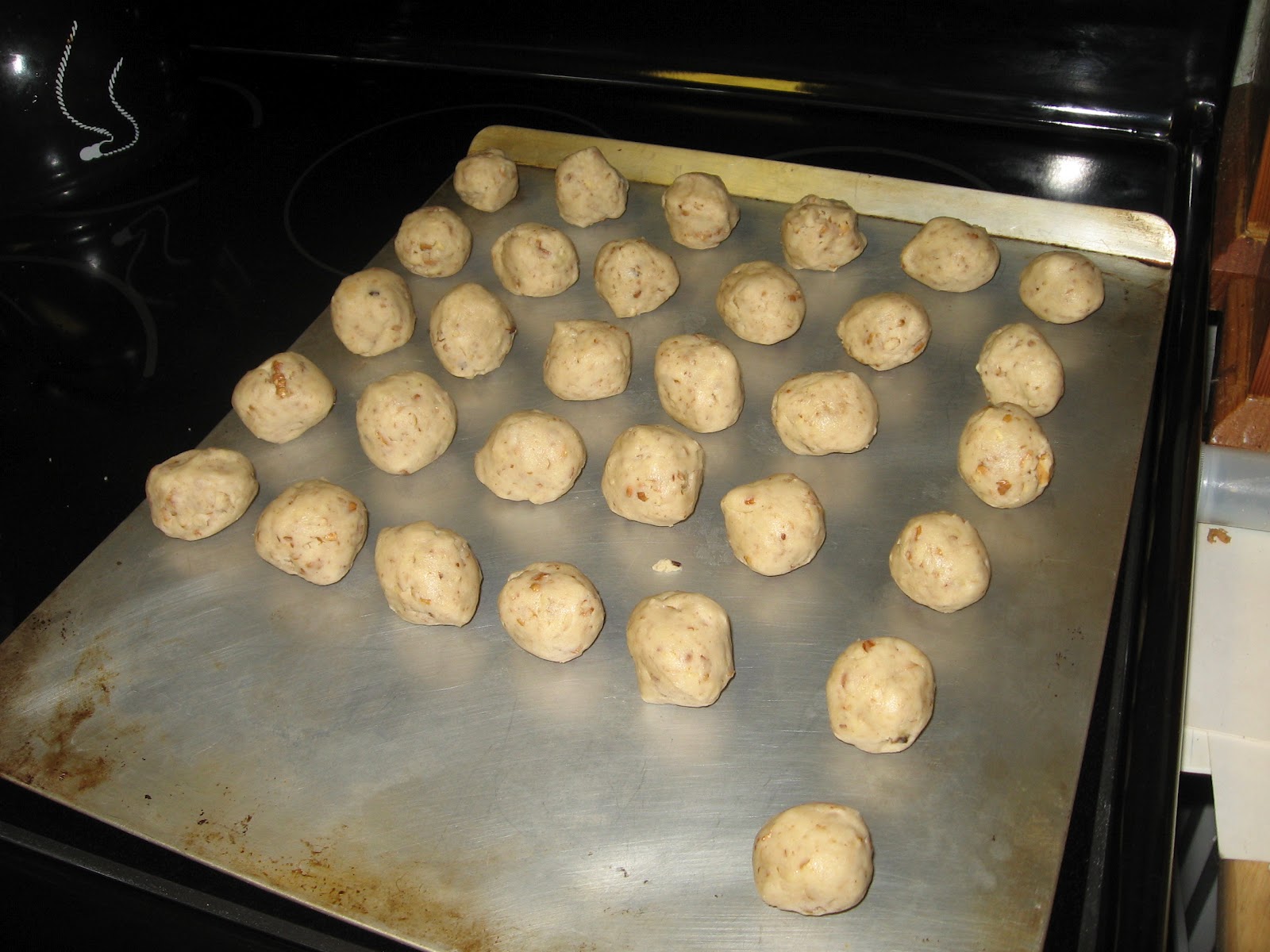
Mix the flour, powdered sugar, nuts, and vanilla into the butter, just until it forms a ball in the bowl.  You want the dough to hold together, but don't overmix.  Refrigerate the dough for an hour or so, in order to make it easier to handle, then form it into small balls on an ungreased cookie sheet.


Cookies ready for the oven


Bake at 350 for 10-12 minutes.  They will be faintly golden.


After baking.  Gold, not brown
Now comes the fun part.  Let the cookies cool for a couple minutes on the baking sheet, then roll them in powdered sugar.As each cookie is rolled in the sugar, place it on a cooling rack.  The sugar will cling to the hot cookies, but it will tend to melt into them because they are still warm.  That's just fine.


You're going to get sugar on your fingers, and that's okay!
 Resist the temptation to nibble, and let the cookies cool.  Because once they are cool, you are going to give them another coat of powdered sugar.  You can also sift powdered sugar over them, but I like to roll them, making sure the entire surface of the cookie has a coating of soft white.

One tip:  If you place your cooling rack over a clean cookie sheet, you can use the powdered sugar that falls off to roll the cookies the second time.  Because there will be sugar that falls off!
After the second coat of sugar, the cookies are ready to be packed in an airtight container, and enjoyed for several days, or weeks.  As if there will be any left that long!   

With a second coat of powdered sugar. Yummy!!

The Cookies of Many Names

2 sticks butter, softened
2 cups flour
2 cups chopped nuts - your choice of pecan, walnut, almond, or hazelnut
1/2 cup powdered sugar, plus more for coating
1/2 teaspoon vanilla

Mix dry ingredients into softened butter, along with the vanilla.  Stir, or mix at low speed on stand mixer.  When the dough forms a ball in the bowl place it in the refrigerator for an hour.  The cold dough will be easier to handle.

Preheat oven to 350 degrees.  Remove dough from refrigerator and roll into small balls, about the size of a walnut.  Place them about an inch apart on an ungreased cookie sheet, and bake for 10-12 minutes, until they turn light gold.  Remove from oven and allow to cool on the cookie sheet for a couple minutes.

While the cookies are still warm, roll them in powdered sugar, coating all sides, and place on cooling racks.  Once they have cooled completely, roll  them in powdered sugar again, and store in an airtight container.

Sunday, July 8, 2012

Panhandling Part 3: Christy and husband Steve Discuss Murder and Mystery on the North Florida Coast

Christy and husband J. Steven York  continue discussing their respective mystery series, both set in the Florida panhandle:

CHRISTY:  When I mentioned colorful characters, I immediately thought about Big Bass, the chief of police in your Panorama Beach stories.  Is he based on anyone you knew, growing up in the South?  I know I've heard stories about a lot of the people that lived around you when you were a kid, but I don't remember any law enforcement people specifically.

STEVE: In Alabama (about 15 miles from the Florida line) we were so far out in the country that we didn't see the law much.  State troopers would cruise through once in a while, and being a fan of cops on TV (re-runs of the old series "Highway Patrol" were a special favorite) I always paid special attention to the cop-cars and motorcycles around city hall.  But as for actually having much to do with actual officers, I don't much remember it.

No, Big Bass is more based on an idea than a person.  Thinking back about the south in that part of the 60s, the legality of segregation in every aspect of society had been broken, but it was still deeply ingrained in the culture.  It struck me that for anyone with visibility to be at all fair-handed with blacks, you had to be something of an outlaw.  Somebody like Big Bass could only survive if he hid his true nature, played the good-old-boy game, and kept enough political dirty tricks up his sleeve to keep himself on top.  So in some ways Bass is that hoariest of southern cliches, the crooked Sheriff.  But he turns that cliche on its head in that he is (sometimes, anyway) a force for good.  Certainly he sees himself as the hero of his story, and he does try to help people and keep his beloved beach from being despoiled.  But his methods are questionable, and he stumbles over to the dark side if there isn't somebody there to turn him back.  Fortunately, there are people to do that, and one of them is Deputy Mustang Sawtell.

Mustang is based on a lot of people I knew, and on some level, he's based on me a little, too.  And I think there's some of my late uncle Wayne in him.  But there's a little of every good-hearted southern boy I've ever met in him.  That's his core.  I just feel that at the core, the character of southern people is kind and generous and hospitable.  But it's also got this strong tradition of intolerance that, to my mind, seems completely incompatible with that.  That dichotomy isn't a southern thing, it's a human thing, and that's a big theme of the Panorama Beach stories.  It's about doing the right thing the best you can when there's nobody to show you the right way, and everything is trying to steer you wrong.  And it's about how good people sometimes do things that are unspeakably evil.

That's really the biggest difference between our two series I think.  In some ways, 1967 and 2012, they might was well be different planets, even through we're talking only a few miles apart.

CHRISTY:  And yet some of the themes you're working with are so universal that they fit any time, and any place.  In writing murder mysteries, we're dealing with characters who do things that are unspeakably evil, who violate the biggest taboo: the taking of a human life.  It doesn't get much worse than that. 

But if we are to create a believable bad guy, he has to have an understandable motive.  He has to think he is doing the only possible thing to achieve his goal, whatever that goal is.  The path that the character takes to  the point where he (or she) commits murder has to make sense to the reader.  Similarly, a character like Big Bass has to make sense within the context of his world, within his definition of necessary actions.

In my books, the victims are killed for a reason.  It might not be what you would call a good reason, but nevertheless the killer must come to a point where killing another person seemed like the only logical path.  And unlike Big Bass, there isn't anyone to pull them back from that murderous impulse.

As you said, however, the South of the 60s and the South of today are definitely different.  Race certainly continues to be an issue within our society, but it does not dominate our social interactions the way it did fifty years ago.  In the Haunted Gift Shop series, I barely touch on the issue, except in occasional historical context.  In fact, I have an interracial couple as secondary characters, and their race is hardly an issue.  The fact that they're gay, well, that may occasionally create problems.

I've noticed something else about your characters, something that certainly reflects the time in which your stories are set.  Many of your characters are military veterans.  What drew you to that background, and why do you think you've made that a central part of so many characters?

STEVE: You know, sometimes you sit down and say, "this is a theme I'm going to write about," and sometimes theme just develops out of story and character.  That's what happened here.

Early on I had the idea that Mustang Sawtell's best childhood friend would have been killed or be MIA in Vietnam, that he would have left him with this Mustang convertible that he drives, that Mustang had never served in the military, and that this would be a source of guilt and conflict for the character.  But as I started writing, it kept coming up again in different ways.

First of all, the military was really pervasive in that part of Florida in those days (and still is).  Panama City had Tyndall Air Force Base, and Eglin Air Force Base near Ft. Walton takes up a huge part of the panhandle with its bombing ranges and satellite airfields.  Then there's the huge Naval Air Station in Pensacola.  It's a very important place for the military, especially military aviation, and it was really buzzing in the 60s, what with Vietnam and the cold-war both in full-swing.  There were military planes in the skies all the time, and you saw military personnel everywhere.

But it's also a matter of history.  In 1967, the WWII generation was in charge of the world, but they were graying, and the world was starting slip from their grasp.  Sheriff Bass is an example of that generation.  We're going to learn that he was a great hero in the Pacific in WWII, saved a lot of lives, and has a lot of friends who remain very loyal to him because of it.  But he also did a lot of bad things in the service of good, and it damaged him in many ways.  He's a danger junkie, and in many ways ruthless.  He's killed many times, and he won't hesitate to kill again if he thinks there's just cause.

Then there's Korea, "the forgotten war," dismissed by many of the WWII generation as "not a real war," and the veterans often treated poorly in a way that echoes the later experiences of Vietnam vets.  My next Panorama Beach Mystery, "The Beat of Angels Wings," delves deeply into this.  It's about a tight group of helicopter pilots who flew air-ambulance missions in Korea, a secret they all share, and how the war has changed them all.  We're also going to reveal that one of our established characters is a Korean vet, someone people might not expect, and their experiences there play a big part in their life.

And of course, Vietnam is looming, not just in Mustang's lost friend, but in the growing unrest in the country that will figure into future installments.

Goofy Golf, Panama City Beach, 1960s
Hmm.  This is getting a little dark and serious.  Let's shift gears and talk about something that I know drew both of us to write about North Florida: the strange, wacky, and wonderful sights and landmarks, both natural and man-made, that dot  (or in some cases, used to dot) the area.  Like some of the things that inspired aspects of Keyhole Bay in your books, and the strange attractions in Panorama Beach.

CHRISTY:  Keyhole Bay is a modern-day tourist town, with all the plusses and minuses that go with an economy based on a constant flow of strangers. In that sense, it has a lot in common with tourist towns across the country; only the geography changes.

The first time I visited Florida, and traveled through the Panhandle, I was astonished.  I'd grown up near the beaches of Southern California, and thought I knew what a beach was all about.  Boy, was I wrong!  The sand was whiter than anything I had seen on the West Coast.  It looked like snow!

All along the coast there were touristy places; restaurants and lodging, of course, but also go-karts, mini golf, souvenir shops, T-shirt shops (LOTS of T-shirt shops), and assorted other attractions.  The wacky, kitschy, slightly tattered tourist attractions had not yet given way to high-rise condos, and I felt like I was a teenager again, at some of the places I'd known in Southern California in the 60s.

In Keyhole Bay, geography has shaped the history and personality of the town.  The small harbor supports both commercial and recreational fishing, and the proximity of the Gulf provides amazing scuba diving opportunities.  So, while it shares much with other tourist towns, it has its own unique attractions.  In Florida, it's all about the water.

One of the places that intrigued me most was DeFuniak Springs, not only for the Chautauqua connection, or the beautiful houses, but for the almost perfectly-round lake.

STEVE:  I loved that lake the first time we saw it.  I'd been driving by it several times every summer, but until a few years ago while visiting with you, I'd never gotten off the main road to see it.  It's like stumbling into some kind of fantasy: the placid, round lake, the historic building, the quaint little small-town main street, the railroad station, and then there's the library.

You go into this tiny little library, and every available wall and shelf that isn't full of books is full of medieval weapons!  It's right out of "Buffy the Vampire Slayer!"  The place demands to be written about, to have some thin layer of fantasy or imagination.  It's a hell-mouth.  It's a star gate.  It's a time-window.  It's the lair of a sea-monster.  It's a bay on a magical fairy ocean in another universe.  It's a place where true love lasts forever.  It's the small town that just happens to be the center of the universe.  It's a town where time moves in circles and loops back on itself in infinite combination.

Sometimes it's that way.  There's a place that's already so special, it just requires just a little twist to turn it into something really special.  I think we both found that in the Florida panhandle...

NEXT: Christy and Steve talk about how writing about fictional towns is still about "keeping it real."

For an important announcement about upcoming "Panorama Beach Mysteries" titles, see HERE!


Sunday, June 17, 2012

Panhandling Part 2: Christy and Steve Discuss Murder and Mayhem On the North Florida Coast


PART 2: Real Places and Imaginary Towns

STEVE: One thing our two mystery series (The Haunted Souvenir Shop, and Panorama Beach Mysteries) have in common, other than being set in the same region of north Florida, is that they're both set in fictional cities, mine in Panorama Beach itself, and the environs of fiction Pascua County, Florida, yours in the town of Keyhole Bay, just a bit further west on the coast.

There are a lot of reasons to write a fictional place, and I wonder if the reasons we did it were the same, or very different.

For my part, I'm writing about fairly recent history, and an area with a fairly small population.  I wasn't trying to write an expose or a literal history.  My initial intent was just to see all those crazy attractions, the fake volcanoes, the concrete dinosaurs, the space-age observation towers, the amusement park midways, and create a mythology of where they came from, and where they went.  But my myth kept trending back towards the truth.  Maybe a bigger, grander, more colorful version of the truth, but real things that happened in Florida and the south back in those days, some I experienced, some I only heard about later, but all, in spirit derived from some kind of truth.

There are even times when you can be more truthful in some way, because you don't have to worry about being sued by real people.  I'm careful to remind people that while sometimes the events I write about have truth to them, the people, relationships, and circumstances are completely fictional.

So, what's your reason for creating Keyhole Bay?

CHRISTY: My reasons and experience are both the same and different.  I do agree that it's nice not to worry about being sued, especially when you have dead bodies piling up!  But I had other reasons, as well.

In many of my previous books I have used real locations, especially in my two Alias novels where I had scenes in places as remote as the Blue Desert in the Sinai, a Russian apartment building, and Deadhorse, Alaska.  My gratitude for travelers who posted reports and photos on the net is extreme.  Doing that research, however, made me realize how complicated using a real setting can be.

The Haunted Gift Shop series, along with the previous Lady Plumber series, require an intimate connection with the location.  I have to know the location of each and every business, the streets and highways, the kinds of houses and neighborhoods, the population demographics - just tons of details.  Of course, every story requires at least some of that knowledge, but these stories are very localized, and the small towns where they are set are almost another character. 

In developing the fictional city of Keyhole Bay, I have control of all those elements, but I am still constrained by the limits of probability.  For instance, I can't have snow storms, but I can have hurricanes, and summer heat.

What restrictions have you discovered in creating your fictional setting?

STEVE:  Well, I think you've hit on something when you say the location is also a character.  I feel very much that way about Panorama Beach, and I think that for a smaller locale anyway, that works better when you fictionalize the place.  With a major city like New York or Chicago or Las Vegas it's fine, because nobody knows everything about them, or expects to.  There are a million untold stories there, and even a local can easily accept that the story you're telling about the city is just one of those.  But you could study a small place like Defuniak Springs or Panama City Beach and know, if not everything, then most of the major stuff about it, and I'm sure there are people with that level of knowledge.

It's also like writing a non-fiction novel about a real person.  You never really know what their most private experiences and inner thoughts are.  You can speculate.  You can go on what they're chosen to share of themselves.  But on some level you have to speculate, just start making things up, or simply have to string the facts of their life together without really being certain how or why those things happened.  But when you make up a fictional character based on a real person, for example the character Charles Foster Kane in the movie "Citizen Kane," who is clearly based on William Randolph Hearst, then the writer can know with great precision everything about them, every secret, every private thought, every hidden failing, and act on them without hesitation.  I never have to ask myself, "was the Chief of Police in Panama City Florida in 1967 a crook or a straight-shooter?  The Chief of Police in Panorama City is a corrupt bad guy, representative of other corrupt lawmen and politicians of the period, if not in that exact place and time.

But you mentioned restrictions in making my fictional setting.  I can't think of many.  In fact, it was very liberating in many ways.  Like you said, I want to know where everything in Panorama Beach is, to the extent that the reader should eventually feel like if they were there, they could get in a car and find their way around based on my descriptions.  I have a map, which continues to be refined as I advance the series, so I can keep it all straight.

If you look at a map of the Panama City/Panama City Beach area, you'll find a lot of similarities.  But for the sake of clarity, I simplified a lot of things, cleaned up coastlines, and the big change, Panama City Beach is on a spit of land that runs from the northwest diagonally to the southeast.  Just for clarity's sake, Panorama Beach in on a spit that runs east-west, with most of the major roads running the same direction, and cross streets are mostly north-south.  It saves confusion for both me and the reader.

How about Keyhole Bay.  Do you have any kind of map?  I know you've at least worked out some of the overall geography.  And it's interesting how the central body of water evolved from the inland, almost perfectly circular lake in Defuniak Springs to the keyhole shaped bay that the town is now named after.

CHRISTY:  I do have a map, although it isn't as well-developed (or attractive) as yours.  Mine is a just a pencil sketch, and you know I'm not an artist!  More important, for my stories, is to know where all the neighboring shops and things are.  A great deal of the map is devoted to laying out the main drag of Keyhole Bay, figuring out who Glory's neighbors are.  One of the other things I spent a lot of time on was the actual layout of Glory's apartment over the store.  A lot of scenes take place there, and I needed to know where everything is in her home.  The same goes for her friends' homes, and her shop.

Moving from DeFuniak Springs was an easy decision.  I still want to use DeFuniak someday as a setting for historical fiction (back to those ladies in hats!), but I also wanted a fictional town for my series, and wanted it to be reasonably close to a larger city.  I spent a lot of time looking at the map of the panhandle before I made my decision.

And while there are lots of limitations from the setting, it does allow me the freedom to create characters-some of them quite colorful-without inviting comparison to real people.


NEXT: Christy and Steve talk about the colorful characters, and where they come from.


Panorama Beach Mysteries: The Best Devil Money Can Buy
AMAZON - NOOK - SMASHWORDS (Also available through all major ebook outlets)
Panorama Beach Mysteries: A Breath Away From Dying
AMAZON - NOOK - SMASHWORDS (Also available through all major ebook outlets)
Panorama Beach Mysteries: Two Bad Days of Summer
(Print collection of both of the above, coming soon)
Panorama Beach Mysteries: The Beat of Angel's Wings
(Ebook coming soon)


Sunday, January 29, 2012

Sunday Morning Musing

Number One Fan, AKA husband J. Steven York,  has been on my case to get back on here and talk to y'all.  Being MIA is understandable and all, but at some point you have to pick yourself up, dust yourself off and get back to the business at hand.


To quote Morgan Freeman, "Get busy living, or get  busy dying."  I choose living.


So I'm going to try and be here more often.


For starters, I want to share some good books with you.  One thing I have discovered is that I tend to read more nonfiction when I'm writing, and I just finished a really interesting book, THE WAVE, by Susan Casey.


I live close enough to the ocean to fall asleep to the sound of the surf.  I love being near the beach.  More than that, I need to be near the ocean.  The flat Midwestern plains?  They make me jumpy-there's no water nearby.  My West Coast roots go deep, I grew up in Southern California is the surfer-60s, and I now live in a tsunami evacuation zone.  (We watched - from a safe distance at the top of our hill - the surge from the Japanese earthquake last year.)  Of course I read this book!


My husband read it first and recommended it to me, and I'm passing along that recommendation.  Here's what he had to say about it:


"As it happens, I just recently finished reading an excellent book about big waves, dealing alternately with big-wave science, big-wave surfers, and the history of giant waves and their impact on people and ships. Amazingly little is known about the huge waves our planet is capable or producing. We don't even know how big they can get, and in fact, scientists are having trouble explaining the biggest waves that have already been reliably been observed. Waves seem simple, but it may actually require quantum physics to decode the mysterious behaviors and energies of giant waves."


And if you're a mystery fan (if you're here, you probably are!) and you haven't yet read any of Julie Hyzy's books, you should.  Her latest White House chef book, AFFAIRS OF STEAK, recently hit the NY Times list.  It's book 5 in the series, and she just keeps getting better!  But start with #1-STATE OF THE ONION.  You won't want to miss a single adventure in our nation's capital.


That's it for now.  I still have some books to write, and some cooking to do, you know.  I'll try to be back more often with bits and pieces from the life of a crazy writer!


Sunday, November 6, 2011

The Fall of a Hero

I've been missing from this blog for several months, and from much of the rest of my world.  I apoligize to my fans for disappearing, and I feel as though I owe you an explanation.  This may take more than one post, but I find myself wanting to talk about what happened over the last year.

You see, I lost my hero, the man I have looked up to and admired for more than 60 years.  My dad.  I want to talk about him, about who he was and what he meant to me.

Over the last couple years I have watched dementia slowly steal the man I knew.  It was heart-breaking to watch this vital, larger-than-life man reduced to a confused and debilitated man battling with his private demons.

In the end he slipped away in his sleep on the 17th of August.  It was both a tragedy and a blessing, and brought grief, relief, and guilt for feeling relieved, in equal measures.  I will always miss him, but the man I grew up with would not have chosen those last months of dependency and loss of control.

Dad wasn't a conventional hero.  He didn't fly planes, or charge into burning buildings, or chase bad guys.  But he was my hero.  There are many things I want to say about him, to tell you why he was important.

I thought I was ready.  I had the words in my head to tell you what I want you to know.  But I still can't.  Sometime soon, I hope.

In the meantime, I hold onto one thing: Just a few days before he died, I got a revised cover image for the first book in the new series (it's getting a couple tweaks, and I hope to have it to post later in the week). 

This is the first book under the Fifield name.  My dad's name. 

I was able to email a copy to my mother, and she took it to show Dad - the first time the name he passed down to me appeared on the cover of a book.

I like to think he approved.

Sunday, April 17, 2011

Cooking Up a New Series - Part Seven - Sweet Potato Casserole

You can tell it's Southern cooking by the parrot!
All of my Southern cooking is an experiment, and some of the results are better than others.  For instance, the problem with the hush puppies (see Part Two).  I had to thicken the batter, and I didn't make notes of my changes so I haven't been able to post a recipe yet.  On the other hand, the fried cornbread came out well and I was pleased with the results (in Part Six).

My first attempt at sweet potato casserole falls in the "less successful" category.  It was tasty, but it wasn't what my expert taste-tester expected and it needs some work.

But I'm not proud - I'm happy to share the tasty failures, too!

Mis en place for sweet potato casserole
The bowl at left is cornmeal for fried cornbread
There are a few tricks I've stolen from cooking shows over the years, and one is the concept of mis en place.  It's a French phrase that means (more or less) "everything in place."

You know how it is when you watch one of those shows, and they have little dishes of every ingredient already measured and ready in a tiny glass bowl?  They never waste camera time measuring, and it's also a great way to determine that you have every ingredient.

In fact as I was setting up for this recipe I discovered that I didn't have miniature marshmallows.  Fortunately the grocery store is only three blocks away.  On a cooking show there would be an able assistant, ready to run do the chef's bidding at any moment.  For me that was the amazing husband/photographer/Official Taster, who ran to the store for marshmallows as I started cooking.


Because the Official Taster prefers yams, that is what I actually used.  Most any variety of sweet potato or yam will work, but that may be part of what went wrong with mine.  I will need to experiment with either different tubers.  But once they were peeled and chopped I put them on to boil until tender.

While the yams simmered, I took a few minutes to clean up the kitchen.  I have discovered that this kind of cooking -  with new recipes and sometimes unfamiliar ingredients - can create a lot of havoc in my kitchen, and lead to many piles of dirty dishes.  Since I have an older house, built at the end of WWII, it doesn't have a dishwasher.  Someday, I have promised myself, we will remodel the kitchen.  Someday!

Bubble, bubble
Sweet potato trouble!

After a few minutes at a slow boil, the yams were fork-tender and ready to mash.  The recipe called for three cups of mashed sweet potato, which seemed like a lot for two people, so I used two small yams and cut the rest of the ingredients in half.  It was plenty, and we even had leftovers.

Once the yams were tender, I drained them in a colander and returned them to the pan to mash them.  I have an ancient hand masher, which was all I needed to smash the yams without completely destroying the texture.
An old-fashioned hand masher works just fine!

However, I think I may have over cooked the yams.  The consistency, as you will soon see, was thinner than I would have liked.  The Official Taster also said it should have been more like dense mashed potatoes than the dish I produced.  Thus the label of Tasty Failure.

But I digress...

Sugar
 The yams were mashed, ready to be mixed, and here is where the mis en place shines!

Once the yams were mashed, I added the remaining ingredients,


Sugar ...

Butter


Butter ...


Milk ...


Eggs and vanilla,
and poured the resulting mash into a baking pan.
Tasty, but way too soupy!

This is when we realized the mixture wasn't as thick as we thought it should be.  There wasn't a lot I could do at this point, so I forged ahead with the topping


A chef's trick, right in my own kitchen
A second mis en place was ready with flour, brown sugar, melted butter, and chopped nuts.  In a concession to the Official Taster I omitted coconut.  Not pictured are the miniature marshmallows my dedicated assistant fetched from the store while the yams were simmering and I was cleaning up the mess from peeling and chopping.


I mixed the nuts, brown sugar and flour into the melted butter, and then added the miniature marshmallows.

I spread the topping over the mashed yams in the baking dish, and it was ready for the oven.


After baking, the casserole was a beautiful, bubbly brown on top, with puffs of golden melted marshmallows. It smelled great, and tasted fine, but it wasn't exactly ready for its close-up.  Here's hoping I can do a better job next time, and show you a finished product that will make your mouth water!


But for the record, here is a plate of the finished casserole.  Too soft to hold its shape, it probably belongs in a small bowl rather than on a plate - it was more like a pudding than a casserole, and it's quite sweet, too.

Stay tuned for more Southern cooking adventures soon!!  Maybe I'll get the pictures for that banana pudding ...


Sweet Potato Casserole


3 cups boiled and  mashed sweet potatoes
1 cup sugar
1/2 cup milk
1/3 cup butter
1 tsp vanilla
2 eggs, lightly beaten

Add sugar, milk, butter, eggs, and vanilla to mashed sweet potatoes.  Place in an oven-proof casserole and top with a mixture of

1/3 cup melted butter
1/3 cup all-purpose flour
1 cup brown sugar
1 cup chopped nuts, pecans preferred, but walnuts also work
1 cup coconut (optional, according to the Official Taster)
1 cup miniature marshmallows

Bake at 350 degrees until brown and bubbly, about 30 minutes